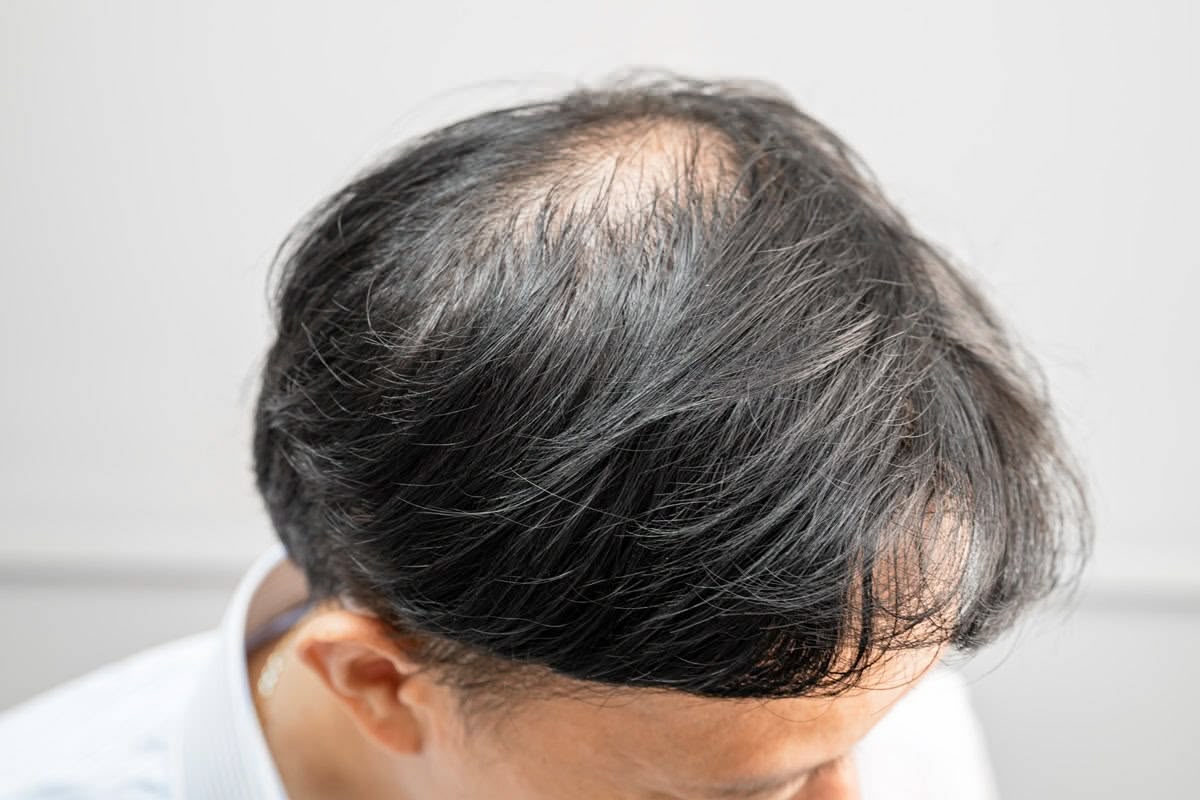
Hair loss has been reported during modafinil treatment, but the published evidence is sparse. Current research does not establish that modafinil causes alopecia or show how frequently hair loss might occur in people taking it.
Key Takeaways
- Alopecia was reported in one participant in a small study of 15 children taking modafinil, but a single uncontrolled observation cannot show that the drug was responsible.
- Hair loss did not emerge as a prominent adverse effect in a pooled safety analysis of six randomized modafinil trials.
- Drug-induced hair loss commonly takes the form of telogen effluvium, but the published modafinil case did not identify the type of alopecia.

Has Hair Loss Been Reported With Modafinil?
A 2006 preliminary study examined modafinil in 15 children with attention-deficit/hyperactivity disorder (ADHD) who could not continue conventional psychostimulant treatment because of an inadequate response or adverse effects.
The participants received a mean modafinil dose of 250.0 ± 103.3 mg per day for an average of 39.2 ± 8.7 days. Decreased appetite was reported in two participants, insomnia in two, irritability in one, and alopecia in one (Yoo et al., 2006).
The study does not describe whether the hair loss was diffuse or patchy, when it began, whether it resolved after modafinil was stopped, or whether the participant was exposed to the drug again.
These details are important when assessing whether a medication caused an adverse event. Without them, the study shows that alopecia occurred during modafinil treatment but cannot establish that modafinil was responsible.
The result also should not be interpreted to mean that 1 in 15 people who take modafinil will experience hair loss. The study was very small, uncontrolled, and not designed to estimate the incidence of alopecia.
What Do Larger Modafinil Safety Studies Show?
Roth et al. (2007) pooled safety data from six randomized, double-blind, placebo-controlled studies involving 1,529 participants with narcolepsy, obstructive sleep apnea, or shift work sleep disorder.
Participants received modafinil at doses of 200, 300, or 400 mg per day or placebo for up to 12 weeks.
Headache occurred in 34% of participants receiving modafinil compared with 23% receiving placebo, while nausea occurred in 11% versus 3%. Other adverse events reported in the pooled analysis included dry mouth, nervousness, insomnia, anxiety, and decreased appetite.
Alopecia was not identified among the adverse events reported in the published pooled safety analysis, although such analyses do not necessarily list every event experienced by every participant.
What Type of Hair Loss Can Medications Cause?
Medications can produce several forms of hair loss, including telogen effluvium, anagen effluvium, alopecia areata, and some forms of scarring alopecia (Alhanshali et al., 2023).
Telogen effluvium is the most common type of reversible medication-induced alopecia. In telogen effluvium, a higher proportion of hair follicles enter the resting phase, eventually leading to increased shedding.
Medication-induced telogen effluvium commonly becomes noticeable around three months after a medication is started (Alhanshali et al., 2023).
There is no evidence showing that modafinil specifically causes telogen effluvium. The 2006 modafinil study reported only “alopecia” and did not identify the pattern or type of hair loss, so classifying that case as telogen effluvium would be speculative.
How Can You Tell Whether a Medication Is Causing Hair Loss?
There is no single test that can prove a particular medication is responsible for hair loss.
Evaluating suspected medication-induced alopecia involves looking at when the shedding began relative to starting or changing a medication and considering other possible causes. Improvement after withdrawal of the suspected medication can provide additional evidence that the drug was involved (Alhanshali et al., 2023).
Hair loss can have many causes, so a medication should not automatically be blamed simply because it was started before the shedding became noticeable.
Should You Stop Modafinil If You Notice Hair Loss?
Hair loss that begins after starting modafinil should be discussed with the clinician who prescribed it. The timing of the hair loss, recent dose changes, other medications, and alternative causes can all help determine whether modafinil might be involved.
Useful information includes when modafinil was started, when the hair loss began, whether the dose recently changed, whether any other medications were started, and whether the loss is diffuse or concentrated in particular areas.
A clinician can consider whether the pattern is compatible with medication-induced hair loss and whether another explanation needs to be investigated.
Do not stop or change a prescribed medication solely because of suspected hair loss without discussing the change with your prescriber.
Does Hair Grow Back After Medication-Induced Hair Loss?
Alhanshali et al. (2023) report that acute medication-induced telogen effluvium can resolve within several months after the causative medication is withdrawn. Visible recovery may take time because affected follicles have to progress through the normal hair-growth cycle.
This cannot be assumed to apply to hair loss reported with modafinil. The published modafinil case did not identify the type of alopecia or describe what happened to the participant’s hair afterward.
References
Alhanshali, L., Buontempo, M., Shapiro, J., & Lo Sicco, K. (2023). Medication-induced hair loss: An update. Journal of the American Academy of Dermatology, 89(2S), S20–S28. https://doi.org/10.1016/j.jaad.2023.04.022
Roth, T., Schwartz, J. R. L., Hirshkowitz, M., Erman, M. K., Dayno, J. M., & Arora, S. (2007). Evaluation of the safety of modafinil for treatment of excessive sleepiness. Journal of Clinical Sleep Medicine, 3(6), 595–602.
Yoo, H. K., Kim, J. Y., Park, S., Jeon, J. W., Wang, H.-R., Kim, B.-N., Hong, J. P., Kim, S. Y., & Kim, C. Y. (2006). Modafinil effect in psychostimulant-inapplicable children with attention deficit hyperactivity disorder: Preliminary study. Journal of the Korean Neuropsychiatric Association, 45(6), 598–603.